Order of work: What watering guidance applies to a Nashville landscape plan?
Metro Water Services asks residents to water no more than three days each week. The guidance is voluntary and is intended to reduce peak demand on the water system.
A design that holds up in Davidson County has to answer two questions at once: what will grow, and what the ground underneath intends to do about it. The planting answer is a palette that tolerates muggy summers, hard winter freezes and heavy clay. The structural answer comes from watching that clay swell after a soaking rain and pull tight again in a dry August. Bed lines, hardscape edges and drainage get laid out around that movement rather than in spite of it.
Residential design and installation runs across Nashville and out through Brentwood, Franklin, Murfreesboro, Hendersonville, Gallatin, Mt. Juliet, Lebanon, Spring Hill, Smyrna and Nolensville. Nothing gets drawn before the site is reviewed: light, soil, how the ground drains, and how much maintenance you actually want to take on. Then we build a planting plan built mostly around native and well-adapted plants.
Written sequence 7 for Design Brief — Key details
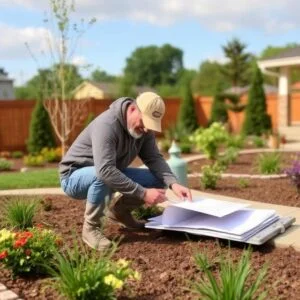
The first visit happens on your property, not over email. We record what is already in place: topsoil depth, the path water takes off the site, how sun and shade move through the day, established trees worth keeping, and anything buried that the plan has to work around. Then we ask what you actually want out of the yard. Some owners want the front to read well from the street. Some want a back yard the family will use. Some simply want beds that still look alive in late August. Measurements, photographs and site notes come back with us.
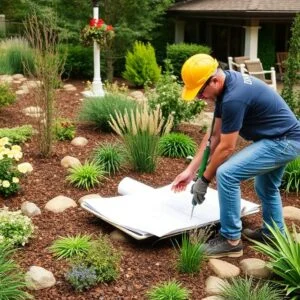
Second comes the plan itself: a scaled planting drawing carrying bed layouts, species and quantities, sprinkler coverage where it is needed, and any hardscape. Every plant appears under both its common and botanical name with mature size and care requirements attached, so nothing about what you are buying is left implicit.
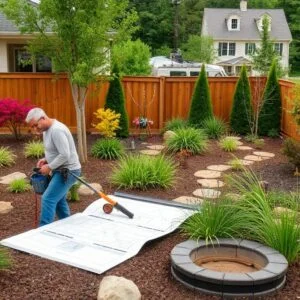
Third comes installation. Beds are dug out to depth and the clay cut with compost and pine fines so it drains. Plants go in at the spacing and depth each one needs. We mulch 2 to 3 inches deep, not the 5-inch mulch volcanoes that kill so many Nashville landscapes. Then we tie in any new sprinkler coverage the new plants need to get established.
Middle Tennessee-Native and Adapted Plant Palette
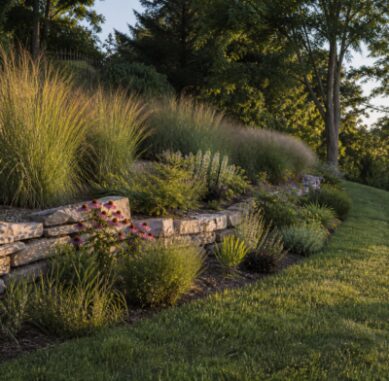
Most of what gets specified either evolved in this region or has proven it can take the local swing from humidity to hard freeze. Purple coneflower, Tennessee coneflower, black-eyed Susan, butterfly weed and native asters carry the flowering layer. Oakleaf hydrangea, serviceberry, Eastern redbud and native viburnums give a bed its year-round shape. Little bluestem, switchgrass and muhly grass supply movement and winter texture. Flowering dogwood and tulip poplar do the heavy lifting in shade and at focal points.
That choice pays off over time. Regionally adapted stock gets by on far less irrigation, feeding and spraying than imported nursery material demands. Five years in, a well-sited native bed still reads as deliberate. A comparable planting of boxwood and daylilies has usually begun to thin out and want replacing by then.
Non-natives still earn a place when a design calls for one, whether that is holly in a hedge, Japanese maple under shade, or clipped boxwood in a formal garden. The backbone of the planting stays regional. Where a requested species is a poor match for the conditions on your site, that concern goes in writing before anything reaches the ground.
The rock under most of this area is limestone, and the clay topsoil resting on it is shallow, frequently 6 to 18 inches before a shovel finds stone. Across the cedar glades of south Davidson and Williamson counties it runs thinner still. Bed construction follows from that. Where digging down is not an option, the beds go up instead, and a raised bed built with an imported soil mix outperforms a dug-in bed in most yards around here.
Water is the other recurring constraint. Clay sheds it slowly, which is harmless in April and punishing in July, when saturated soil and heat together suffocate roots. The remedy is grade: gentle slopes, French drains where a site demands them, and berm-and-swale shaping that moves water past the planting instead of collecting it around the crowns. Each plan accounts for where a 3-inch rain actually ends up.
A full install treats the property as a single job: front yard, back yard, planting beds, trees, irrigation, mulch and final cleanup in one mobilization. Time on site tends to run from about a week to three depending on how much ground the plan covers, with check-in visits continuing for roughly six weeks afterward while everything settles.
Phasing splits the work into two or three rounds, generally by area or by season, so the cost is spread and the first stage can be seen finished before the rest is committed to. Typically that means the front in spring, the back once fall arrives, and specialty beds or hardscape a year later. Where patios, walls or walkways form part of the plan, it dovetails with our hardscape team.
Written sequence 2 for Design Brief — Key details
Design work seldom stands alone. An install almost always touches lawn mowing, because new planting changes how a yard is cut; it touches hardscape, because bed lines meet patios and walkways; and it touches irrigation, because fresh beds need drip run to them. Running the whole property through one team keeps those pieces in step, and stops the same scope being billed twice.
Written sequence 8 for Design Brief — Timing Choices
Request a free quote or a consultation and we will walk the property with you. Pricing is flat and set before work begins, and the design fee is credited against the install if you go ahead. See our service areas page for coverage, or call (615) 334-9088.
We handle landscape design for homeowners across Nashville and nearby, including Landscape design in Gallatin, Landscape design in Spring Hill, Landscape design in Nolensville, Landscape design in Lebanon, and Landscape design in La Vergne; see all the areas we serve.
We provide landscape design across Nashville and nearby communities, including Landscape design in Gallatin, Landscape design in Spring Hill, Landscape design in Nolensville, Landscape design in Lebanon, and Landscape design in La Vergne — see all areas we serve.
Planning and planting resources
What sequence should organize Landscape Design?
Put the Nashville landscape design inquiry into a property details covering affected areas, constraints, desired decisions, and available records. Require separate statements for scope, responsibility, payment, and revisions.
Process Overview
- Site assessment and consultation
- Written estimate with line-item scope
- Scheduled work window confirmed
- Crew executes against the written estimate
- Completion walkthrough with the homeowner