Order of work: How is a Nashville hardscape scope evaluated?
Middle Tennessee clay, limestone, slopes, drainage outlets, excavation access, and material selections determine the work; drawings and quantities make those Nashville conditions reviewable.
Two things decide whether hardscape here lasts: the base and the drainage. What you actually look at — the paver patio, the flagstone walkway, the retaining wall — is finish work. The part that decides the outcome sits underneath it: the 4 to 12 inches of crushed stone laid first, and the drainage planned before water can gather against a wall or beneath a patio.
Leave that base prep out and freeze-thaw winters will pull the hardscape apart inside two years. Tennessee clay swells wet, shrinks dry and heaves frozen. Set a patio straight onto it and expect cracking, settlement and a lip within two years; build a wall with no drainage and it will lean, crack or blow out in the first heavy rain. We have rebuilt enough of other crews’ failed installs to know exactly what goes and why.
We install patios, walkways, retaining walls, fire pits, and stone features across Nashville and the suburbs. That includes Brentwood, Franklin, Murfreesboro, Hendersonville, Gallatin, Mt. Juliet, Lebanon, Spring Hill, Smyrna, and Nolensville.
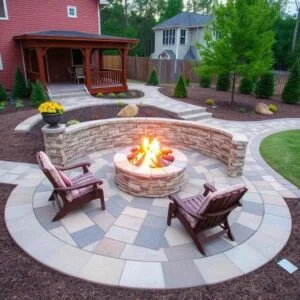
Paver patios use interlocking concrete pavers like Belgard, Pavestone, or Unilock. We set them over a 4 to 6 inch packed stone base with polymeric sand joints. The steps: dig down 7 to 9 inches, pack #57 stone in 2-inch lifts, screed a 1-inch sand bed, lay the pavers with tight joints, compact them, and sweep sand into the gaps. Price runs $18 to $28 per square foot installed. It depends on the paver, the pattern, and how easy the site is to reach.
Flagstone patios use Tennessee fieldstone, Pennsylvania bluestone, or Oklahoma flagstone. The look drives the choice. Flagstone runs $22 to $35 per square foot installed. The odd shapes and thickness make it slower to lay than pavers. But it gives a natural look that fits wooded lots and the older homes around Franklin, Brentwood, and central Nashville.
Retaining Walls
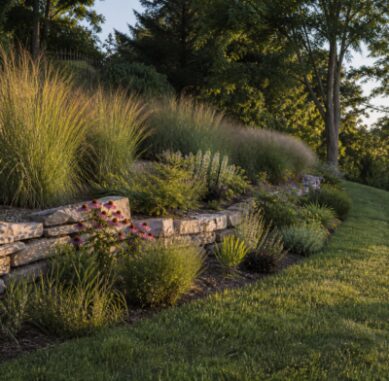
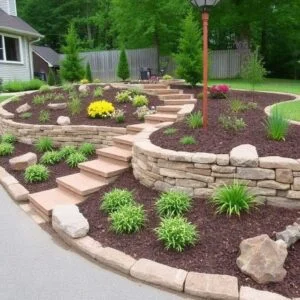
Nashville’s rolling land means a lot of yards need retaining walls. They manage grade between the house and yard. They hold slopes on Brentwood and Franklin lots. And they carve flat, usable space out of a steep backyard. The wall type depends on height and soil.
For walls under 3 feet, block systems like Versa-Lok, Keystone, or Pavestone handle most homes, set on a proper base with good backfill. For walls 3 to 6 feet, we add geogrid into the backfill for strength. For walls over 4 feet, Tennessee code requires engineered drawings from a licensed engineer. We handle that engineering as part of the job.
Every wall we build includes drainage. That means a perforated pipe at the base, #57 stone backfill for the first 12 inches, and filter fabric between the stone and the soil. Skip any of the three and the wall fails. So we never build them without it.
Gas and wood-burning fire pits are the most asked-for feature in Nashville. Wood pits run 36 to 48 inches across. They are simpler and cheaper, just a stone or block ring on a fireproof base, usually $2,500 to $5,000 installed. Gas pits cost more but turn on instantly and let you control the flame. With the gas line, burner pan, media, and ignition, they run $4,500 to $12,000.
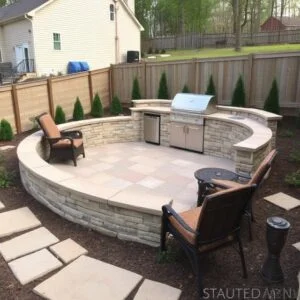
We also build outdoor kitchens and pergola footings. We bring in carpentry partners for the shade structure. And we add stone accents like boulders, seat walls, and columns.
Three things make hardscape here different. One: the clay moves with moisture and heat. So a crushed-stone base is a must, not sand, not granite. Two: the freeze-thaw cycle. Nashville sees 15 to 30 freeze-thaw swings each winter, and the build has to take that movement. Three: limestone bedrock can sit close to the surface. We have hit solid rock at 18 inches in Green Hills and Forest Hills. That needs breakers or rock saws to dig, which some crews do not own.
We have built in these conditions long enough to know where things fail. That is why our base is 6 inches in most cases, not the 3 to 4 some crews cut to. It is why we use polymeric sand on every paver joint, not plain sand. And it is why every wall gets a drainage pipe, even when the design does not strictly call for one.
Written sequence 1 for Built-Feature Scope — Key details
Hardscape work ties in with the rest of the property. It pairs with landscape design, since bed lines run against patios and walls. It pairs with irrigation, since lines must be routed before we build. It affects mowing, since new hardscape changes the pattern. And it ends with cleanup after the install.
Written sequence 6 for Built-Feature Scope — Written estimate Request
Our free on-site estimate covers a site look, a material talk, and a flat written quote. We quote on real scope, not “starting at” ranges that climb during the build. Ask for a free quote or check our service areas page for coverage. Call (615) 334-9088.
Our hardscaping crews work throughout Nashville and the surrounding towns, including Hardscaping in Hendersonville, Hardscaping in Mount Juliet, Hardscaping in Smyrna, Hardscaping in Gallatin, and Hardscaping in Spring Hill, and across all the areas we serve.
We provide hardscaping across Nashville and nearby communities, including Hardscaping in Hendersonville, Hardscaping in Mount Juliet, Hardscaping in Smyrna, Hardscaping in Gallatin, and Hardscaping in Spring Hill — see all areas we serve.
Nashville hardscaping guides
How should the walkthrough lead into scheduled Hardscaping?
Middle Tennessee clay, limestone, slopes, drainage outlets, excavation access, and material selections determine the work; drawings and quantities make those Nashville conditions reviewable.
What’s Included
- On-site walkthrough with the lead crew member
- Written estimate before any work begins
- Service window confirmed in writing
- Final walkthrough and quality check